Shravanabelagola - A Historic Pilgrimage Site
Shravanabelagola, located in the state of Karnataka, is a historic Jain pilgrimage center in South India, approximately 2,300 years old. It is renowned for its Jain scriptures, culture, and architecture.
The name Shravanabelagola (earlier known as Indragiri) is said to have originated from the “listeners” (śrāvakas) who gathered near the white lake situated between the Vindhyagiri and Chandragiri hills to hear the sermons of Jain monks (Muniraj). In Kannada, this lake was called Bili-Bhagwan, meaning “white pond.”
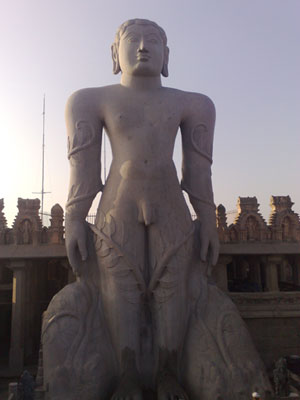
On the Vindhyagiri hill stands the majestic 57-foot monolithic stone statue of Lord Gomateshwara Bahubali. This statue was consecrated in 981 CE by Sri Chamundaraya. Every 12 years, the grand Mahāmastakābhiṣeka (head-anointing ceremony) of Lord Bahubali is performed, benefiting millions of devotees.
To climb the Vindhyagiri hill, one has to ascend 647 steps. The hill also houses eight other small and large Jain temples.
Facing Vindhyagiri stands the smaller hill, Chikka-Betta (Chandragiri Hill).
Chandragiri is named after Emperor Chandragupta Maurya, who lived here in the 3rd century CE. To climb this hill, there are 192 steps. The hill houses 18 Jain temples, small and large, built around the 9th century CE.
Inside the Shri Neminath Bhagwan temple, beautiful murals depicting the life of Lord Neminath have been carved and painted. In the open courtyard stands a magnificent idol of Shri Bharatesh Muni. From here, one gets an extraordinary view of Lord Bahubali, seated majestically on the opposite Vindhyagiri hill.
The antiquity of Chandragiri is also confirmed by the Bhadrabahu Cave, the Bhadrabahu Foot-Impressions (Charanapaduka), and inscriptions carved here dating back to the 6th century CE.
Here, the Jain temples are known by the name “Basadi” or “Vasati.” At the foothill, around the Jain Matha, are situated the famous Bhandara Basadi, Manastambha, Akkana Basadi, Manga Basadi, Siddhanta Basadi, Nagar Jinalaya, and the Kalyani Temple.
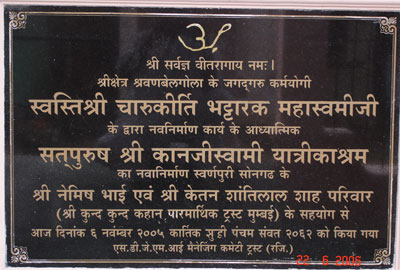
Jain culture is so prominent here that a “National Prakrit Research Center” has been established. This institution preserves nearly 6,000 palm-leaf manuscripts using scientific methods. The library houses a collection of about 20,000 texts. The center also offers studies in Jain philosophy, history, art, literature, and the Prakrit language. Ancient Jain Āgamas preserved in manuscript form-such as Gommatsāra, Tiloyapaṇṇatti, Ādipurāṇa, etc.- are available here. The Jain Matha manages a large complex of guesthouses and dining halls, including the newly added “Shri Kanjiswami Yatri Nivas.”
Near the complex, a museum displays beautiful artworks depicting the story of Bharata-Bahubali and exhibits items such as the grand Mahākuṁbha used during the Mahāmastakābhiṣeka ceremony.
Vikram Samvat 2015.
The first visit to Shravanabelagola by Pujya Gurudev.
On the morning of Maha Vad 9, Pujya Gurudev arrived at Shravanabelagola from Hassan. Immediately after the welcome, Pujya Gurudev, along with the saṅgh, proceeded to the Vindhyagiri hill for the pilgrimage of Lord Bahubali… This hill is very beautiful and about 600 steps high. One can reach the top in about quarter of an hour. …Upon reaching the top, the moment Gurudev saw the 57-foot-tall Bahubalinath, he was struck with wonder and devotion… he stood amazed… again and again he looked at the Vitaragi Lord with deep feeling. …After beholding the valiant and detached Bahubalinath, he expressed great joy. Accompanying Gurudev on this pilgrimage to Bahubalinath also filled Behenshri-Ben with immense enthusiasm and devotional feelings. First, a collective worship of Lord Bahubali was performed… Pujya Gurudev led the devotion (such as Aise Rishabhanandan dekhe van mein… etc.). Then Behenshri Ben also led a devotional hymn.
After that, Gurudev once again had the divine sight (darshan) of Lord Bahubali… and recited several devotional mantras. He also offered reverence at the shrines of other deities present on the hill, as well as the stone inscriptions. In this manner, with great joy, enthusiasm, and devotion, Gurudev, along with the entire sangh, completed the pilgrimage of Lord Bahubali at Shravanabelagola and then descended the hill.
Salutations to Gurudev who undertook the pilgrimage of Bahubalinath.
Even during the afternoon discourse, Gurudev expressed the joy of the pilgrimage by describing the greatness of Lord Bahubali. There are many Jain temples in the village of Shravanabelagola as well.
At night, a devotional session was held in the temple of the twenty-four Tīrthankaras.
Journey to Chandragiri
On the morning of Maha Vad Dasham, Pujya Gurudev, along with the sangh, proceeded for the pilgrimage to Chandragiri, the second hill of Shravanabelagola. This hill contains around 14 ancient Jain temples, highly significant ancient inscriptions, and the cave of Acharya Bhadrabahu. This mountain is the samadhi-site of 500 monks. One of the temples houses a large idol of Lord Parshvanath. In another temple-constructed by King Chamunda-ancient paintings depicting the lives of Bhadrabahu and Chandragupta have been engraved. This is the oldest temple on the hill, and it is here that Acharya Nemichandra Siddhanta Chakravarti composed the Gommatsara.
After the temple darshan, worship and devotion were offered before the 15-foot tall idol of Lord Shantinath. Among the many ancient inscriptions here, written in the Kannada script, Acharya Kundakund is mentioned with great reverence. One inscription refers to him as “the knower of all remaining (unrevealed) principles of reality.” Additionally, inscriptions such as “Vandayo vibhubhmavi na kairiha Kauṇḍakundah,” which are printed in texts like Samaysar, are located on the left side of the Parshvanath temple. Gurudev and the devotees viewed them with great enthusiasm.
After this, they visited the cave of Acharya Bhadrabahu, which contains his ancient footprints. There too, darshan was performed and an arghya was offered.
Jinnathpuri
After completing the pilgrimage of Chandragiri dham, Gurudev, along with the saṅgh, proceeded to the village of Jinnathpuri situated at the foothill on the other side, to have darshan of two Jain temples. In one of these temples resides Lord Pārśvanāth-the very idol in front of whose photograph Pujya Gurudev Shri performed parivartan (transformation of sect) in Songadh.
In the afternoon, Gurudevshri visited five other temples in the village of Shravanabelagola. Among these, Akkan Basadi and Mangan Basadi were built by two sisters called Akka (elder sister) and Mangi (younger sister). In the Akkan Basadi temple, the pillar of Kasauti (touchstone) features beautifully carved ancient artwork. Seeing it immediately brings to mind the ancient grandeur of Jain Dharma. At night, Gurudev visited the Bhattarakji's temple and had darshan of various types of Jain idols.
The second pilgrimage to Lord Bahubali and the Abhiṣeka
On Maha Vad 11, Gurudev once again went with the saṅgh to visit Lord Bahubali, who is enshrined atop Vindhyagiri. With deep devotion, Gurudev performed the abhisheka on the holy feet of Lord Bahubali. Through contributions collected for this abhiṣeka, along with those gathered for the Rathayatra, nearly ten thousand rupees were raised. This amount will be used to make this pilgrimage memorable.
After the abhiṣeka, Gurudev repeatedly turned back to look at Bahubalinath… “Nirakhat trupti na thāye”-he simply could not gaze at the Lord enough, as though he wished to keep looking at Him endlessly! He then offered heartfelt devotion and worship.
Having completed this second pilgrimage and abhiṣeka of Lord Bahubali with immense joy and devotion, Gurudev descended the hill along with the devotees, all singing and worshipping with great enthusiasm. The devotees were extremely pleased with this second pilgrimage.
During the afternoon sermon, while speaking about the rarity of the conditions leading to Bhedgyaan, Gurudev said: “See, this unobstructed, serene, passionless Lord Bahubali is unparalleled in this world-He is a cause for Bhedgyaan. Standing with radiant consciousness, this Lord Bahubali reveals the true nature of pure consciousness.”
After the discourse, the sisters from the South offered a devotional bhakti with great fervor.
Focus-light Darshan of Bahubali (Third Visit)
In the evening, along with a few devotees, Pujya Gurudev again ascended Vindhyagiri to behold Lord Bahubali in the illumination of focus lights. Gurudev offered darshan with deep emotion… with great concentration… with a devotional heart. In the peaceful atmosphere, seeing the radiant posture of that valiant, dispassionate saint, everyone felt immense joy. And the beloved Bahubali Dev… “Jin tō vandan karūn hazār bār… Nāth nē vandan karūn hazār…”-this devotion was beautifully sung by Pujya Behenshree Ben.
After joyfully taking darshan of Bahubalinath and descending the hill, the people of Shravanabelagola welcomed Gurudev grandly in the village. Seeing such a heartfelt reception for Gurudev, the devotees felt great delight. People would say: “Just as you experienced immense bliss upon seeing Lord Bahubali, in the same way we experience immense bliss upon seeing Kanjiswami.” In this manner, with great happiness and devotion, the pilgrimage to Lord Bahubali was completed.
Vikram Samvat 2020
The second pilgrimage to Shravanabelagola by Pujya Gurudevshri
On the day of Maha Sud 6, they arrived at Shravanabelagola. From nearly 15 miles away, pilgrims can see the head of Bahubalinath seated atop the hill of Shravanabelagola. At night, devotion was performed in the temple before the idols of the twenty-four Tirthankaras.
On the morning of Maha Sud 7, devotees, together with Gurudev, reached near the Vindhyagiri hill for the pilgrimage. As they climbed the hill and saw Bahubalinath after 15-20 minutes, everyone was amazed, filled with joy and delight. The sight of this passionless, serene idol brings such peace and bliss that it cannot be expressed adequately in words. Gurudev too gazed repeatedly at that sacred posture with astonished eyes.
After that, two pūjās of Lord Bahubali were performed, and along with Gurudev, Behenshri-ben also led devotional singing. In this way, they joyfully completed the pilgrimage and came down.
There, the people of the southern region enthusiastically welcomed Gurudev, taking him around the village. After the welcome, Kannada students honored Gurudev by offering a lamp, flowers, and other items, and they also sang a welcome song in the Kannada language.
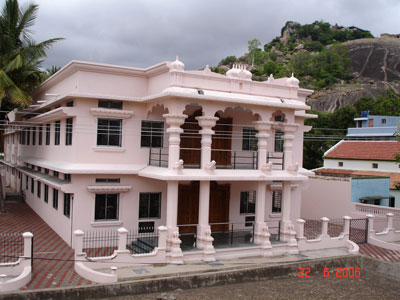
From the amount of about ten thousand rupees collected five years earlier during the pilgrimage for the abhiṣeka of Lord Bahubali, a four-room house has been built here, which has been named “Shri Kanjiswami Yatrikāshram.”
Arrangements for Gurudev's stay were made there itself. Its inauguration took place at the same time when Gurudev arrived. In the afternoon discourse, Gurudev beautifully described the life of Lord Bahubali in a wonderful manner. At night, everyone again went up the hill and, in the light of the focus lamps, beheld the sacred posture of Bahubalinath... Ah! With every repeated viewing, new and deeper devotional feelings arose.
Gurudev was also extremely pleased. Standing before the image of Lord Bahubali in the terrace, Gurudev, with deep emotion and great joy, said:
“Look! Just look at His face! What extraordinary, divine expressions ripple across it. The intensity of merit and the purity-both appear utterly extraordinary. The knowledge is so deeply absorbed within that there is no space for it to emerge outward. In the state of vītarāga, the knowledge is completely immersed. On His face rests an infinite, wondrous serenity of detachment-as if a cool glacier of consciousness itself! There is nothing else like this in the entire world.”
Gurudev expressed many such sentiments.
The waves of emotion that arose upon beholding Bahubalinath were beyond expression - it felt impossible to put them into words. After that, there was deep and heartfelt devotion to Lord Bahubali. Pujya Behenshri-Ben, too, poured out devotional fervor with great joy. Repeatedly undertaking this pilgrimage to Bahubalinath with Gurudev filled her and all the pilgrims with immense happiness.
Today, Gurudev's joy during the darshan of Bahubalinath was something truly unique. With such great bliss, after seeing Bahubalinath, offering devotion, and completing this second visit, everyone descended the hill… and after listening to the story of Lord Bahubali's renunciation-filled life, they all went to sleep.
The next morning, all the pilgrims, along with Gurudev, again went up the hill to visit Lord Bahubalinath and perform the sacred anointing (abhisheka) at His feet. After the worship, the foot-abhisheka was performed with great devotion.
When Kahan-Guru began the abhisheka with a golden pitcher, the pilgrims danced with immense joy. After the abhisheka, Gurudev led devotional singing. The hymn “Jangal vasāvyu re santoe…” was sung by him with deep renunciation and emotion. After that, Pujya Behenshri Ben also led devotion with hymns such as “Vindhyagiri par Bahubalinathji bhale birājo ji…”.
Remembering the blissful pilgrimage of the day, while sitting before Lord Bahubali, Gurudev wrote- “Victory to Lord Bahubali… Victory to the nectar of bliss.”
After that, embracing Lord Bahubalinath, seeing Him, touching Him, and singing auspicious hymns, all of them completed the pilgrimage and descended the hill. Many pilgrims then went for the pilgrimage of the small hill opposite-Chandragiri. There they saw many ancient temples, inscriptions related to Acharya Kundakunda and others, and in the cave of Bhadrabahu Swami they saw his 15-inch-long sacred footprints. At each place there were darshan, worship, and devotion.
In the afternoon, they visited the Jina idols in the Bhattarak temple. After seeing the paintings depicting the life of Bahubali Swami, Gurudev, in his discourse, glorified Lord Bahubali extensively.
Vikram Samvat 2031.
The third visit to Shravanabelagola by Pujya Gurudevshri
In the city of Bengaluru, on the auspicious day of Chaitra Sud 13, the birth celebration of Lord Mahavir was observed with great enthusiasm. Auspicious consecration ceremonies of the Jinendra Lords were performed in the beautiful Jain temple and in the Samavasaran temple.
Despite the difficulty of understanding Hindi and Gujarati, the inquisitive devotees from the southern region participated lovingly in the festival and were completely captivated after witnessing the grandeur of the Panch Kalyanaks of the Lord.
After that, Gurudev, along with the sangh, undertook the pilgrimage to Lord Bahubali, who is seated in a meditative posture at Shravanabelagola. Ah! The monk absorbed in pure detachment- as if he is placing his hand on the heads of devotees, giving them auspicious blessings. Seeing the firm and unwavering self-discipline of the Muni, even a spiritual seeker feels inspired to pursue inner discipline.
Ah, O Lord! For a thousand years, countless virtuous souls have beheld Your supremely peaceful, detached posture and been inspired towards non-attachment and the path of liberation. You are the eternal wonder of this world.
How wondrous is the state of a true seeker! If you wish to see it, look at Bahubali.
How deeply detached a seeker becomes from the world - if you wish to see it, look at Bahubali.
What profound peace resides in the state of pure consciousness - if you wish to see it, look at Bahubali.
How heroic a seeker truly is - if you wish to see it, look at Bahubali.
Blessed Bahubali, who abandoned family for the welfare of his soul… for you renounced the entire world.
You left behind wealth, grandeur - everything - realizing the world is transient… for you discovered the world to be without true essence.